


When ChatGPT arrived back in late 2022, I had one of the biggest professional confidence crises of my career.
I’d spent the past two decades building a career as a writer - first as a journalist, and then in the corporate world of communications, brand and marketing. Suddenly, it seemed as though the skill I’d spent decades developing was being turned into a commodity. More than one person in my professional network asked me whether I thought writers were still going to be needed in five years’ time.
For the first time in my career, I found myself wondering whether the thing that had always made me valuable was about to become completely irrelevant.
After a few sleepless nights, and a lot of soul searching, I eventually realised I needed to reframe my thinking, or I was going to send myself completely mad. It was clear that AI was here to stay, and that it could produce words. But could it really do all the things I was especially good at? Could it decide which stories needed to be told to which audience at which time? Did it really have an instinct for why a particular message would work, and another would fall flat?
There was also another, deeper question I needed to consider. Why had I allowed a new technology, and by extension the workplace I had created as a consultant around it, be the sole judge, jury and executioner of my professional worth?
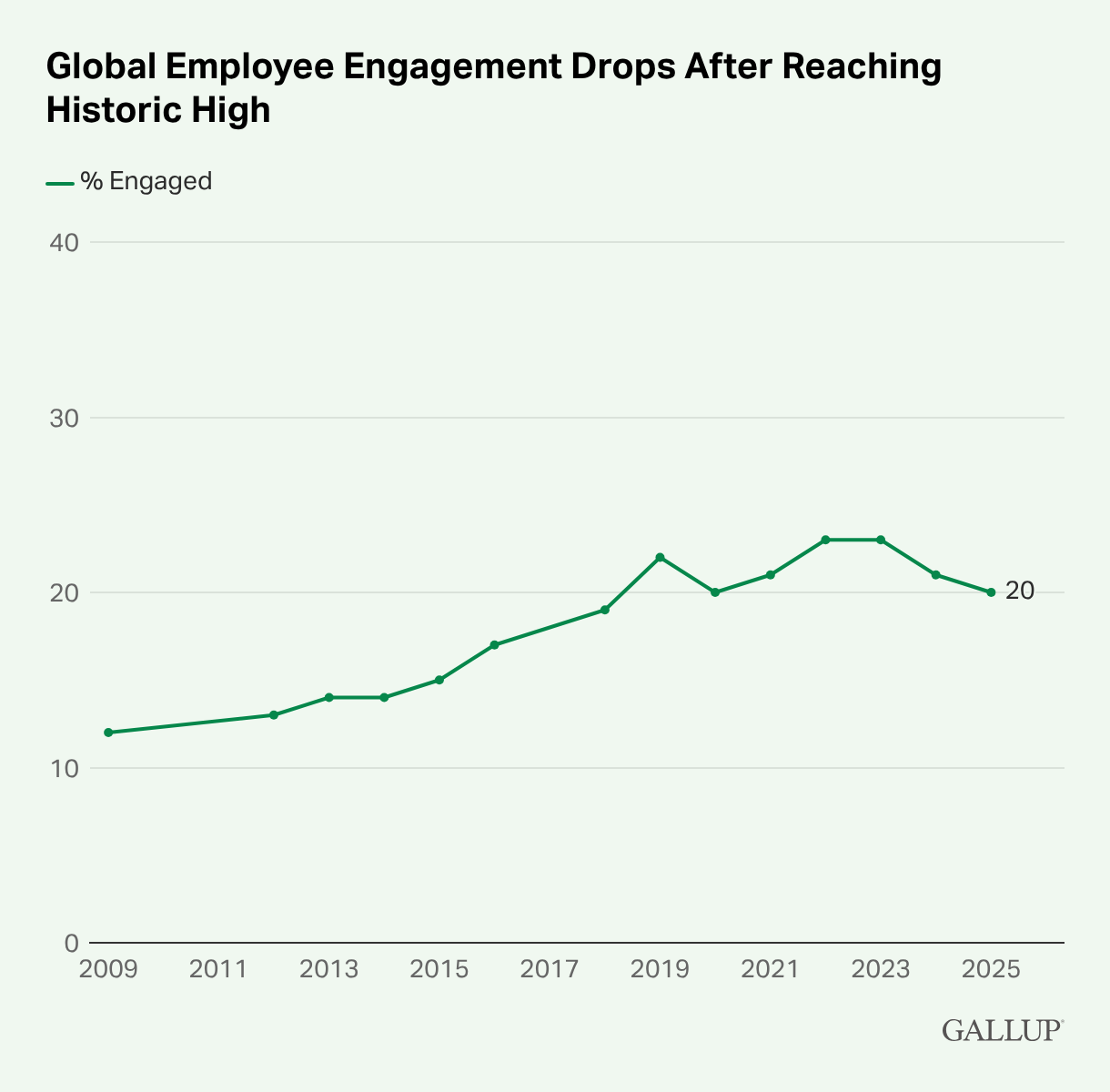
Interestingly, it was around the same time I was having my professional crisis that research firm Gallup first reported that employee engagement had started falling globally, after years of steady improvement. What’s more, it’s continued to fall every year since 2022.
Which raises the question… what’s been going on in the world of work to degrade the experience for so many of us over the past three or four years? If I reflect on my own situation, I can see that AI impacted my enjoyment of work as I started to doubt my professional worth. Do the declining engagement numbers support that theory, or are there other factors at play?
This week’s newsletter reflects on these questions. As always, love to hear your thoughts, comments and feedback on this!
Spoiler alert: it wasn’t just me
If you zoom out to look at Gallup’s data, there are two clear phases: a long rise from the early 2000s into the early 2020s, then a noteworthy reversal after 2022. The trend spans countries, industries and job types.
Notably, in many countries disengagement has been rising at the same time as engagement has been falling, which means employees haven’t been falling into a state of neutrality - they’re actively checking out.
It’s important to note that engagement is influenced by many factors, both internal to the company (your manager, workload and the culture), as well as external factors (life circumstance, the economy). There’s no single event to explain this global trend.
That being said, it is a trend and it’s difficult to ignore. My theory is that several major challenges hit us at around the same time.
The balance of power changed
During the Great Resignation of 2021-22, millions of workers voluntarily left their jobs looking for better pay and more flexible conditions. Employers were competing hard for talent, and many employees felt like they had options. If they were unhappy, they could find something better.
By late 2022, as the economy slowed down, that era started winding down. Many companies moved focus from growth to efficiency, and we started seeing more layoffs around this time. The return to office (RTO) conversations started to gather momentum not long after that.
It was also around this time that ChatGPT brought generative AI to the public consciousness. Even though it was still fairly rudimentary technology in the early days, many professionals started picking up signals about the future of knowledge work as a result.
By 2023, the mood of the global workforce had changed. The confidence that many of us felt in previous years was fading, and we were starting to hear the old familiar tropes: “efficiency, shareholder value, doing more with less”.
What we were experiencing was the balance of power starting to move back towards employers, and the signals we were receiving about our own value at work as a result.
We stopped feeling like an investment
As a writer, I pay keen attention to language in the workplace and how it affects what we do and the way we feel about what we’re doing. When organisations move from growth to efficiency, you’ll notice a subtle change in the language.
“Our people are our greatest asset” might become “we’re optimising for shareholder value and efficiency”.
And more recently, “people-first” organisations have become “AI-first” organisations. (I think this will become a source of branding regret in the years to come, but that’s another thought for another time.)
People notice when the language of the organisation switches away from investment and development and toward productivity, efficiency and cost reduction. If you’re like me, you notice it straightaway. If not, it embeds in your subconscious and you start picking up the signals over time.
It’s little wonder that many of us stopped feeling like an investment in the future, and started wondering whether we were simply another cost to be managed. And more recently - whether we could simply be replaced by a machine.
Who gets to decide your value?
For me personally, as I look back I think the biggest mistake I made was allowing my current working environment, and even the broader corporate environment I was operating in at the time, to become the main source of my professional self-worth.
Whether you work with clients like me, or for a single employer, that’s an easy trap to fall into. After all, we’ve spent years or even decades building careers around the notion of the traditional corporate ladder, and your progress against that benchmark is typically measured by promotions and annual performance reviews. This really reinforces the idea that work is where we discover our value.
However, there are a few challenges with this mindset. First and foremost, the traditional corporate ladder seems to be disappearing. Secondly, organisations don’t actually exist to validate us - even if we’d like them to do so. They exist primarily to deliver certain outcomes, and sometimes those outcomes are efficiency. When the economy is thriving, we’ll get more validation as companies compete to hire and retain the best talent. When the economy is not so healthy, as it is right now, the opposite tends to apply.
If your sense of professional worth depends entirely on how your employer perceives your value, you’re in for a bumpy ride.
A quick reframe
Looking back, the biggest lesson I’ve taken from the past few years is that I was giving too much weight to the signals I was receiving from the world of work.
When AI arrived on the scene, I interpreted it an indictment on my profession. When companies started talking about its link to efficiency and cost reduction, I interpreted that as a judgement on my value. Neither of these interpretations was true.
Now I understand that companies have every right to change strategy as markets change. There will always be new technologies that change the way we work. It’s naive to think otherwise. What’s really changed for me is adopting this quick reframe:
Your employer (or client) rents your skills. They don’t own your professional identity.
That identity belongs to me. It’s been build over years of experience and the unique composition of my brain. I get to choose the work I put into the world, and no new technology can take that away from me.
If there’s one thing you take away from all this, please let it be this: don’t let your employer become the sole source of your professional self-worth. Businesses and technology will come and go. Your value is bigger than either of them.
One thing I’m thinking about this week
One of the reasons I started this publication is that some ideas need more depth than what I can provide in a 90-second soundbite on Instagram. Now I’ve come to realise that some ideas are easier to explore in conversation than on the page.
In that spirit, from next week I’ll also be publishing a companion Track Changes On podcast to go with each newsletter. It will touch on the same themes as the written version, but with a few extra thoughts that don’t always make it in.
If you prefer listening on your commute or while you’re squeezing in your daily work, I hope it will become another way for you to connect with the ideas I’m discussing right now.
I’m looking forward to sharing the first episode with you next week!
Things I’ve made (and you can buy)
If you enjoy my content and would like to support my work, here are a few things I’ve created.
🛒 Track Changes On Shop - Coffee mugs for corporate rebels
📖 Do Give Up Your Day Job - Guide to corporate exits and transitions to self-employment
Funny enough, I was reading Gallup’s report a few days ago and struggling with a similar question: what changed!? There’s obviously no single answer but I keep coming back to your point about language. Corporate language has become increasingly humanistic over time (take purpose, belonging or authenticity) while the employment relationship seems to have become increasingly transactional. I don’t think all that language is cynical but as trust has eroded the gap between what organizations say work is and how the relationship actually feels has become harder to ignore. I wonder how much that contradiction itself is contributing to disengagement.
“Your company rents your skills but doesn’t own your professional identity” is a powerful reminder that we have more power than we think!