


When ChatGPT arrived on the scene a few years back, I had a fairly personal reason to pay attention. I make my living mostly from writing.
Like many people in creative and knowledge-based professions, I watched as headlines declared that AI could now write articles, marketing copy, emails and reports in seconds. Almost overnight, it felt like everyone had decided they were a writer.
I had a few sleepless nights of existential panic as a wondered what this meant for me. If a machine can produce thousands of words at the click of a button, surely that changes the economics of writing? Surely it changes how clients think about value? For a while, it seemed as though the conversation was heading in one direction: AI would make human writers less relevant.
What I’ve found since then is a little more nuanced than that. Sure, AI can create content. It can create words. Lots and lots of words. The cost of producing content has fallen dramatically and it continues to fall.
What fascinated me was what happened next. People are now more attuned than ever to bad content and “AI slop”, potentially in a way they weren’t a few years back. That’s actually opened up the path for great writers to shine once again.
Right now in the corporate world, and indeed across much of society, we’re about to grapple with some important questions about what happens when something that used to be scarce suddenly becomes abundant. It applies far beyond writing. It affects careers, businesses and the way we think about value itself.
This week’s piece explores this in greater depth, including what it means for you. It started life as a short Instagram video, so here’s the 90-second version if that’s your preference… otherwise, read on!
AI will change the way we perceive value
Every major technology wave makes something easier to do, and by extension, it makes it cheaper.
The internet made information cheaper. Spreadsheets made calculations cheaper. Streaming made access to entertainment cheaper.
Right now, AI is making things many things easier to do, and therefore cheaper to produce. Content, images, code, analysis… you name it, AI is here to do it.
When that happens, it’s easy to focus on what’s being lost. The more useful question might be where value travels next.
There’s a psychological concept called the Scarcity Principle, which I briefly discussed in the video above. Put simply, humans tend to place a higher value on things that are rare than things that are abundant.
It’s why people pay more for handmade products than mass-produced ones, and why limited-edition items command a premium. The scarcity itself becomes part of the value.
Technology has a habit of changing what’s scarce. It’s a pattern we can see throughout history.
The accountants who didn’t disappear
Before Excel and other spreadsheets became commonplace, accountants spent a significant amount of time performing calculations manually. The work was labour-intensive and often repetitive.
Then spreadsheets arrived and dramatically reduced the time required to perform those tasks. Calculations became easier and cheaper to produce.
At that point, the value of the accountant changed.
Businesses still needed people who could interpret the numbers, identify risks, evaluate options and help leaders make decisions. In many cases, accountants became more influential because they could spend less time producing information and more time helping organisations understand it.
The value of the role moved from calculation to interpretation.
The travel agents who survived
Travel agents experienced a similar disruption a few years back. Before the internet, travel agents held something valuable: access to information.
If you wanted to compare flights, hotels or holiday packages, you needed a travel agent to do it for you. They had access to systems and information that most consumers didn’t.
Then the internet arrived, and suddenly everyone could compare flights from their lounge room. Many travel agencies disappeared because their competitive advantage disappeared.
However, there were travel agents who not only survived, but prospered. These were the ones who found a different source of value. They specialised in complex itineraries, luxury experiences, difficult logistics and personalised advice.
People stopped paying for access, and started paying for for taste and experience.
Again, the value moved. Neither profession disappeared; the source of value changed.
AI is creating a similar moment across many professions
I think AI is creating a similar moment across a broad range of professions. For the first time, we’re making certain forms of knowledge work dramatically more abundant: content, images, code, research and even basic analysis. The cost of producing these outputs is falling rapidly.
That doesn’t automatically mean the people who work in those fields become less valuable; more often it means that the source of value changes.
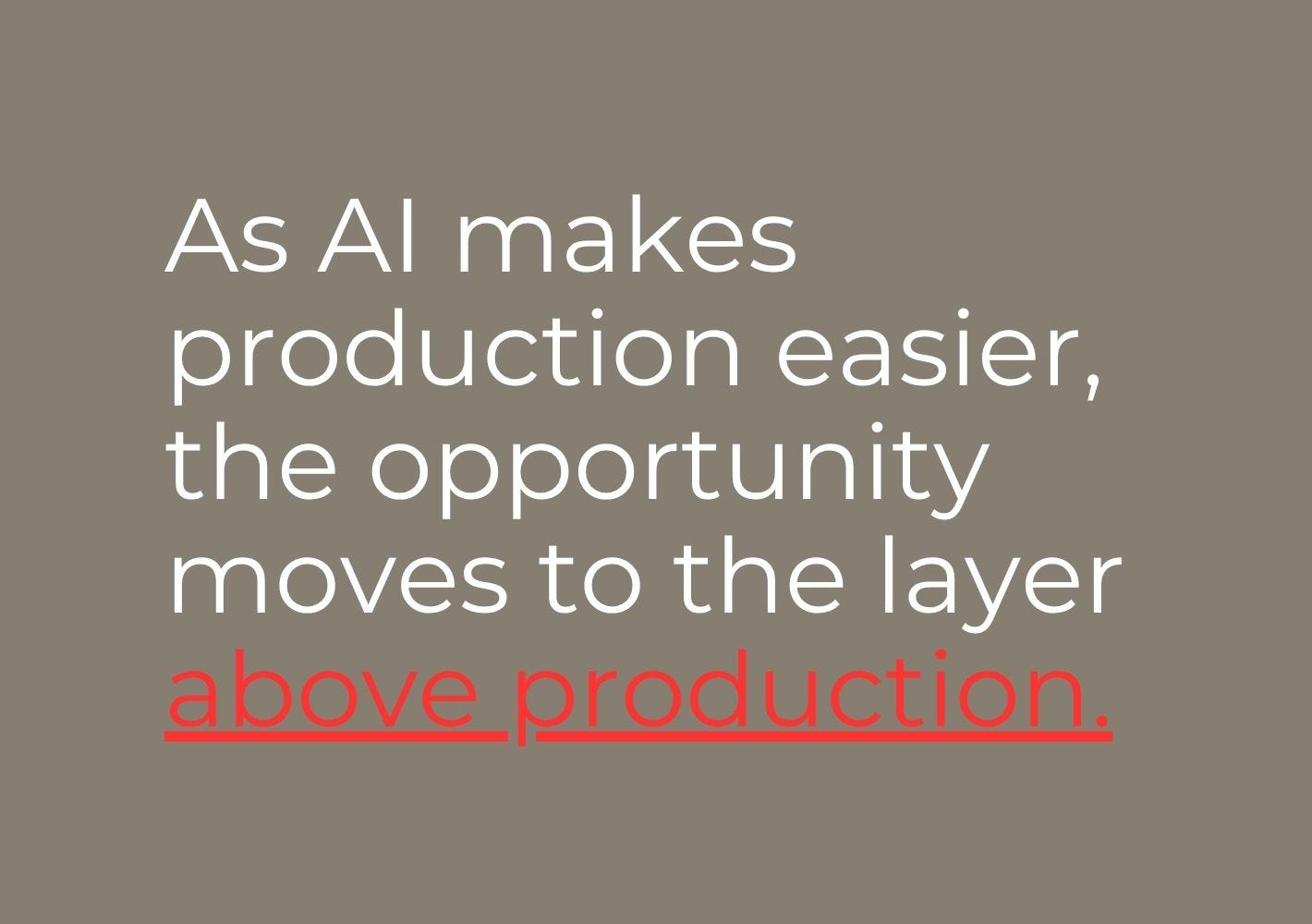
As AI makes production easier, the opportunity may move to the layer above production. That’s the space where humans decide what matters. Where we build trust.
How to apply this thinking to your own career
Think about your own job or business for a moment. Whatever it is you do to make money.
How much of your work involves producing something? That includes things like:
reports
presentations
spreadsheets
proposals
even emails
Now ask a different question. How much of your value comes from deciding what should go into that deliverable in the first place? Those are not the same thing.
AI is becoming increasingly capable of helping us produce work. And before you come at me with a “but… but… AI agents” - no, AI agents can’t make the same kinds of judgement calls that humans can.
AI is far less capable of understanding organisational politics, navigating competing priorities, managing relationships or deciding which of ten possible options is the right one.
This is why I’m becoming sceptical of the idea that becoming more machine-like is the best response to AI. The people who thrive in periods of technological change are often the people who move towards the next layer of value first.
For instance, the spreadsheet automated calculations, while the valuable work became the interpretation.
Similarly, search engines gave everyone access to information. The people who benefited most became the people who could analyse information, connect ideas and make better decisions because of it.
AI is automating parts of production. The valuable work may increasingly become deciding, prioritising, connecting and influencing.
A simple career audit
Here’s a simple exercise you could try this week. Make a list of the tasks you perform most often, and mark up the ones AI could plausibly help with.
Then look at what’s left. It might include things like conversations to gather knowledge, making decisions, influencing people in the organisation or interpreting context. Even things like the ability to connect dots that others can’t see.
That list of leftovers is probably where your future value sits.
For employees, this might mean investing more heavily in communication, influence, problem-solving and decision-making. For leaders, it may mean spending less time creating information and more time helping people make sense of it.
For business owners, it raises a different question. If every competitor in your industry had access to exactly the same AI tools tomorrow, what would still make customers choose you?
Your relationships?
Your reputation?
Your expertise?
Your understanding of customers?
Your ability to solve difficult problems?
Those are much harder to replicate than any standalone deliverable.
What’s about to become scarce?
Every major technology wave creates anxiety because it changes the rules. People naturally focus on what’s becoming cheaper. History suggests it’s equally important to pay attention to what’s becoming more valuable.
AI is making many forms of output abundant. If everyone is producing more, the greater value could be focusing on what’s becoming scarce and invest there first.
One thing I’m thinking about this week
This post popped into my Instagram feed this week and I just couldn’t help myself.
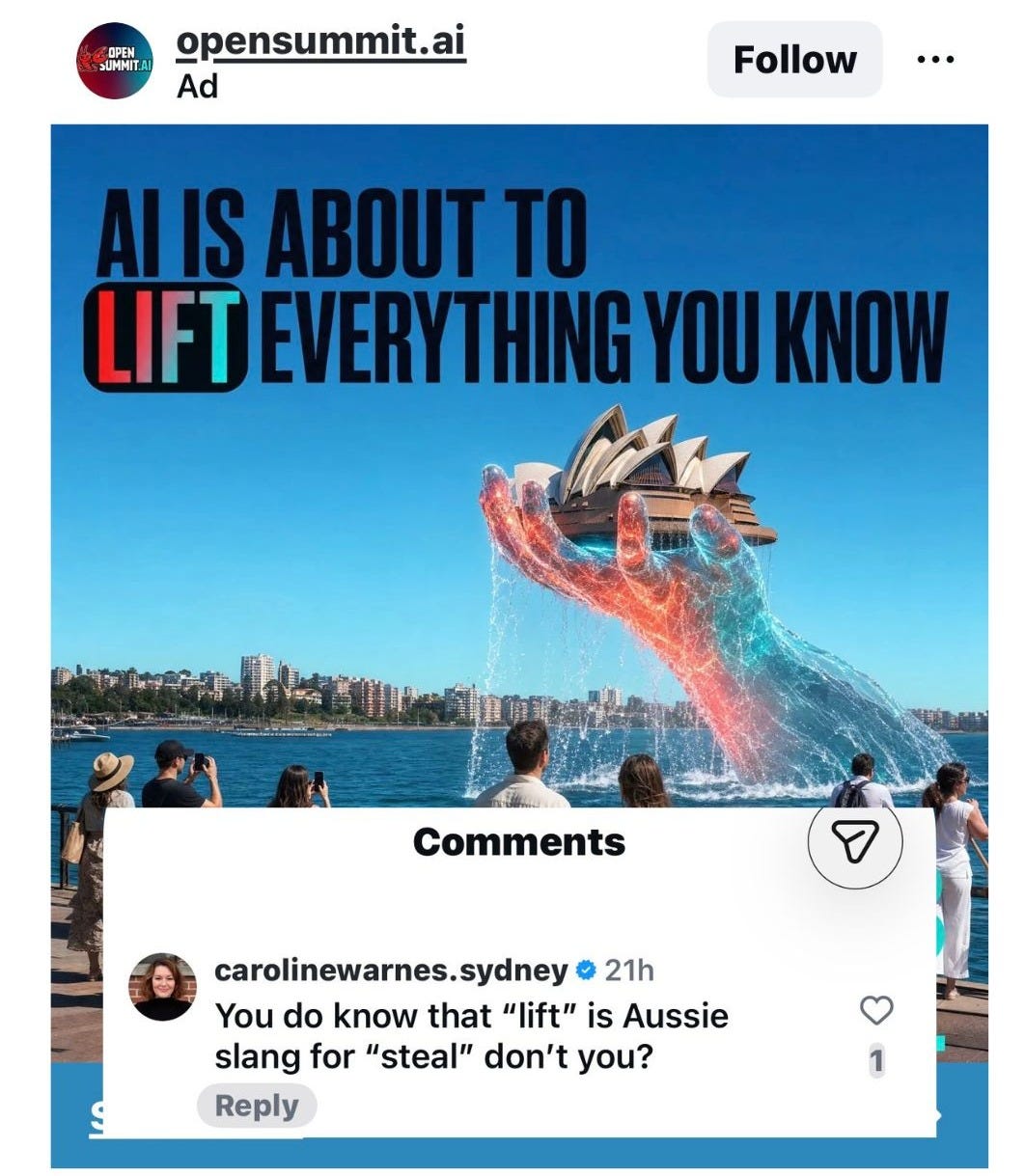
I know, I know. I’m not as funny as I think I am. But seriously… a classic example of why you need to have a human overseeing your content. Someone with an understanding of cultural nuance, because otherwise you leave yourself wide open for f**k ups like this.
Find me elsewhere
📸 Instagram | 🧵 Threads | 🔗 LinkedIn
Things I’ve written and made
🛒 Track Changes On Shop - Gifts and office merch for corporate rebels
📖 Do Give Up Your Day Job - Guide to corporate exits and transitions to self-employment