


About two years into my last corporate role, I reached a point when I realised I no longer really believed the story the organisation was telling.
The irony of this situation was that I was helping to write it.
As the leader of the communications department, the CEO would set the direction and I’d translate it for the organisation. The words were mine, but it no longer felt like they belonged to me.
I found myself trying to reconcile the messages I was crafting with what I was seeing every day inside the business - and things just weren’t adding up for me.
I spent a lot of time wondering whether I was missing something. I have a cynical streak, so I always have to check to see if I’m running hot in that department. I asked myself whether I was being unfair. I even spent many sleepless nights questioning my own resilience and eventually, my perception of reality.
Looking back, I think I was carrying around a form of cognitive load that I didn’t have the language for at the time. My body kept the score, however; as I’ve previously shared, I burned out in spectacular fashion towards the end of my tenure.
As it turns out, I wasn’t alone in struggling with this mismatch between what I was hearing at work and what I was seeing.
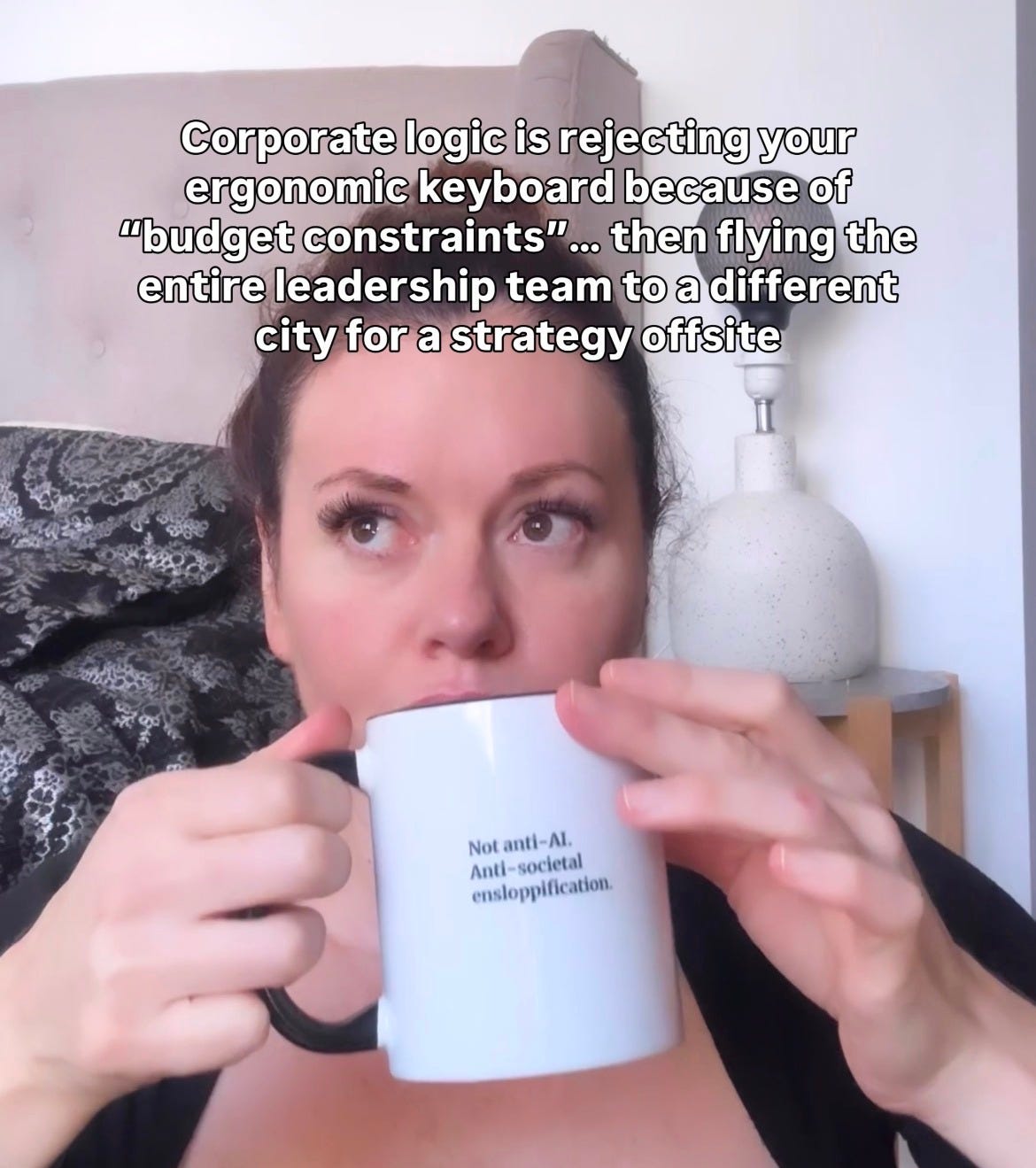
Lately I’ve been posting a series of tongue-in-cheek Instagram videos called Corporate Logic. They highlight the common contradictions many of us experience at work, and they’ve resonated far more than I expected.
Why does this affect us so deeply?
Across several videos, the comments revealed that people were describing the same feeling in completely different situations. It wasn’t really about keyboards, strategy offsites or office budgets. Instead, there’s something more fundamental at play.
As humans, we have an entirely predictable reaction when there’s a gap between what organisations say and what we consistently experience.
You’ve probably heard some of these examples…
“We care about wellbeing.”
Then workloads increase because of a hiring freeze.
“We encourage innovation.”
Then every new idea disappears into layers of approval.
“Our people are our greatest asset.”
Then basic requests are declined while money appears elsewhere.
Most of us understand organisations are complicated. We know different budgets exist, and that every decision has context. However, it gets harder to maintain that understanding when those contradictions stop feeling like isolated decisions, and start feeling like a pattern.
That’s when it becomes much harder to make sense of work.
When words and actions stop lining up
Organisational psychologists have a term for this process: sensemaking. It’s how we build an understanding of what’s really happening around us. We listen to what leaders say, we watch what happens around us and, often without realising it, we piece those signals together into a picture of how the organisation really works.
Most of the time, that process happens in the background. When words and reality stop lining up, it comes to the fore. We start asking ourselves questions…
Maybe I’ve misunderstood?
Perhaps there’s context I don’t have?
Am I overreacting?
Those questions don’t just disappear when the work day ends. They follow us home. We replay conversations and look for an explanation that makes everything fit.
The thing is, that process actually requires a fair bit of cognitive effort. It may not even be conscious to us, but it consumes attention and energy all the same. I think it’s one of the hidden forms of mental work we rarely acknowledge when we talk about burnout.
When sensemaking becomes part of the job
Most of us think of work as the tasks we’re paid to do. However, if you’ve ever found yourself replaying conversations on the drive home, trying to work out what someone really meant, you’ve been doing another kind of work as well.
You’ve been trying to make sense of the organisation itself.
That work is invisible. It doesn’t appear on your calendar, and no one thanks you for it. Yet it still consumes time and attention. Every contradiction creates another question to answer.
Did they really mean that?
Why was that decision made?
Am I missing something?
Has the organisation changed, or have I?
Those questions are mentally expensive because they rarely have a clear answer or resolution.
What’s the link to corporate burnout?
Burnout is one of the defining workplace conversations of our time. We usually explain it through workload, unrealistic expectations or constant change. I wonder whether we’re overlooking another contributor.
What happens when people spend months, or even years, trying to make sense of an environment that no longer feels internally consistent? When part of the job becomes working out whether you can trust your own interpretation of what you’re experiencing?
That uncertainty creates mental work. It’s difficult to focus fully on your job when part of your attention is constantly occupied by trying to make sense of the environment around it.
I’m not a psychologist and I’m not suggesting this is the major cause of burnout. I do wonder whether it’s one piece of a much bigger picture.
After all, if three-quarters of employees report experiencing burnout (source: Spring Health’s 2026 Workplace Mental Health Annual Report), we’re no longer talking about individual resilience alone. We’re looking at something systemic. Workload is clearly part of the story, but perhaps the invisible effort of trying to make sense of contradictory workplaces deserves more attention too.
What can you do to manage this?
Looking back, I wish someone had given me permission to trust my own observations a little sooner - just enough to stop assuming I was always the one who had misunderstood.
With the benefit of hindsight, there are a few things I think would have helped.
Look for patterns, not isolated moments.
Every organisation makes decisions that seem inconsistent. One decision tells you very little; repeated patterns tell you much more.
Write things down.
If you find yourself replaying the same meeting over and over, make a few notes while it’s still fresh.
What was said?
What happened?
What felt inconsistent?
It gets the thoughts out of your head and makes them easier to examine objectively later.
Talk to someone outside the organisation.
This was probably the biggest one for me. Find someone who isn’t immersed in the same culture, because they won’t be invested in defending it or criticising it.
You need someone to help you test your thinking and point out context you’ve missed. Sometimes you just need someone to say:
“No, I can see why that doesn’t make sense to you.”
Validation of your experiences can immediately relieve some of the cognitive pressure. Either way, you've stopped carrying the entire burden of making sense of it by yourself.
Wrapping it up
I don’t think organisations will ever eliminate contradictions completely. They’re complex systems made up of people and competing priorities. There will always be imperfect decisions. That’s just life.
With that in mind, the goal can’t be to find a workplace that never sends mixed signals. Hell, I work for myself now and I still receive them. It’s part of working with other people. We all bring different perspectives, assumptions and communication styles.
The difference is when making sense of those signals becomes a job in itself. When you spend more time trying to interpret what’s really going on than simply getting on with your work, that’s something worth your attention.
Invisible mental work is still work, and you’re not officially being paid for it. If you’re carrying enough of it for long enough, it’s time to ask yourself what it’s costing you.
One thing I’m thinking about this week
If you follow me on Instagram, you might have seen that I escaped to the Blue Mountains over the weekend.
My son and I are both homebodies, so we don’t take many trips away, but it turned out to be exactly what we needed.
There’s something about spending time in nature that helps quiet all the noise. You stop overthinking and trying to solve every problem. Things that felt complicated a few hours earlier suddenly seem much more manageable.
Maybe that’s why I found myself thinking about this week’s topic while I was there. Sometimes the best way to make sense of something is to step away from it for a while.
And what a place to do it…

Things I’ve made (and you can buy)
If you enjoy my content and would like to support my work, here are a few things I’ve created.
🛒 Track Changes On Shop - Coffee mugs for corporate rebels
📖 Do Give Up Your Day Job - Guide to corporate exits and transitions to self-employment
This hit for me today. Because I think the narrative we sometimes fall prep to, is thinking we're alone, but maybe we're going crazy. I think yes there are some things we can do at an individual level, but I agree with you in that I think at the heart of the problem is that it is systemic.
Spot on, love it. Particularly the burnout connection, the psychological tax of the contradictions is not talked enough.